


Friendly Manners for a Comfortable Life in Matsudo 快適に暮らすためのマナーガイド
更新日:2026年8月19日
Everyday Manners Flyer / 暮らしの中のマナーのチラシ
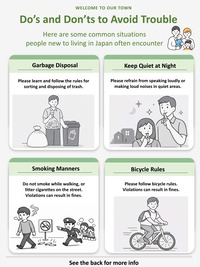
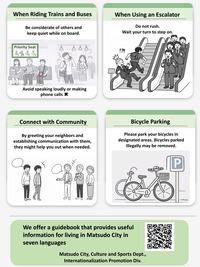
 Matsudo City Guide to Everyday Manners / 松戸市 生活のマナーガイド(PDF:745KB)
Japanese customs, social rules, and etiquette / 日本の習慣、ルールとマナー
- Housing & Daily Living / 家・暮らし
- In Public Spaces & On Streets / 公共スペース・道路
- Manners in Parks / 公園利用のマナー
- Playing with Hand-held Fireworks / 手持ち花火の使用について
- Life with Pets / ペットとのくらし
Housing & Daily Living / 家・暮らし
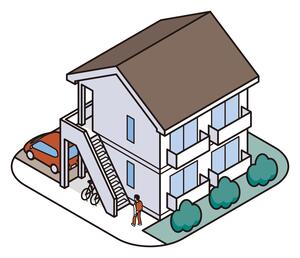
When renting an apartment or a house
- Do not wear outdoor shoes inside the residence.
- Only the person listed on the lease agreement is permitted to live there, and you cannot allow others to live there without permission. Subletting is also prohibited.
- Do not leave items in common areas such as hallways or staircases.
- The rented residence must be returned in its original clean condition. Do not drill holes in walls, paint surfaces, attach fixtures, or cause severe damage or mess.
- You cannot keep a pet without your landlord's permission.
Please confirm the detailed rules with your landlord or real estate agent and follow them accordingly. When moving out, remember that you must cancel not only the lease but also your electricity, gas, water, and internet services.
REFERENCE:
Noise
Some common noise issues in apartment living include loud footsteps and doors, playing instruments, and TV and music sounds. Vacuum cleaners and washing machines also require consideration of usage times, and their use should be avoided particularly during late night to early morning hours (e.g., 10:00 PM to 7:00 AM).
These noises can be annoying to neighbors living below or next to you, sometimes leading to disputes with neighbors or result in police intervention and warning.
Disposing of household waste
In Japan, detailed rules and schedules are established for sorting and disposing of household waste. While the varying rules by municipality may seem confusing or troublesome, we ask for your cooperation to avoid neighborhood troubles and to help maintain the environment in your area.
※Garbage collection points located along roadsides may be restricted to residents belonging to the neighborhood association that manages them. Please check with your local neighborhood association.
For details, please refer to the page explaining “Sorting and disposal of household garbage.”
REFERENCE:
'Sorting and disposal of household garbage'
Neighborhood associations
By joining the neighborhood association, you gain access to the garbage disposal area managed by the association. Additionally, participating in seasonal events, disaster drills, and cleanup activities with your neighbors foster community connections. This allows you to check on each other's safety during emergencies like disasters and receive necessary support quickly.
Membership is voluntary and not mandatory, but an annual fee is required to participate. Those living in rental properties may also join if they wish.
REFERENCE:
'Neighborhood Associations PR Animation'
Social insurance and taxes
Health insurance premiums, pension contributions, and taxes are mandatory obligations for everyone living in Japan. Failure to pay by the due date may affect your eligibility to reside in Japan, so please be careful.
The amount you pay is determined individually based on your income from the previous year. Therefore, it is important to save money so that you can make your payments even if unforeseen circumstances arise, such as a pay cut after changing jobs.
If you experience difficulty making payments, please promptly consult the city hall.
Consultation service for foreign residents:
Public Enquiries Office (Koho Kocho-ka, Kocho Tanto-shitsu)
REFERENCE:
'National Health Insurance and National Pension'
Keep away from breaking the law unknowingly
The following acts are crimes in Japan and could get you into unexpected trouble.
- Smoking and drinking by persons under the age of 20.
- Foreign nationals without a valid residence status going out without carrying their passport.
- Using another person's commuter pass, health insurance card, cash card, bankbook, mobile phone, or similar items; or lending or selling yours to others for use.
- A person other than the actual user entering into contracts for banks, mobile phones, rental housing, etc.
- Carrying any type of blade longer than 6 centimeters or a pepper spray.
- Bringing marijuana or other drugs into Japan, or possessing, using, or transferring/selling them. Some prescription medications like cold medicine or painkillers may contain substances prohibited from being brought into Japan (such as codeine), so please check in advance.
In Public Spaces & On Streets / 公共スペース・道路
Noise
On streets, in parks, inside stores, and on public transportations (including station concourses, trains, and buses), please refrain from talking loudly, playing musical instruments, or playing videos or music at high volume. In particular, talking on the phone or watching videos with sound on trains or buses is generally considered a faux pas. Please be mindful and keep conversations to a minimum.
On trains and buses
- Speaking loudly or talking on your cell phone on the train is considered bad mannered. Please adjust the volume of your headphones so that the sound from your music or videos does not disturb those around you.
- When boarding, please wait for passengers to get off before moving forward.
- When the train is crowded, hold large backpacks in front of you or place them on the overhead rack to avoid bumping into others.
- Avoid placing luggage or lying on seats to take up more than one person's space, as this inconveniences others.
- Eating and drinking on regular trains and buses are considered disruptive behavior due to the potential for mess, odors, and litter. (Shinkansen bullet trains, limited express trains, and long-distance buses are exceptions.)
Eating and drinking in public spacees
- Eating, drinking, or consuming alcohol while walking or standing outdoors is generally frowned upon. Sitting on curbs or steps along roads or sidewalks obstructs pedestrian traffic. Please use the designated eating areas or benches instead.
- Most restaurants prohibit bringing in outside food.
- Leaving uneaten food is considered poor etiquette, so please order only what you can eat.
Photo and video shooting
- Consideration for Others: Be mindful of those around you and your safety, and take turns when photographing. Particular caution is required when using tripods or flashes, or when photographing on roads with vehicles or pedestrians.
- Permission: Obtain permissions before photographing/filming someone directly. Photography is prohibited in certain areas, such as inside temples and shrines. Always comply with “No Photography” signs when displayed. For commercial photography, you must obtain permission from the administrator, even in public places like commercial facilities, stations, or parks.
- Privacy and Image Rights: Avoid focusing on specific individuals. When posting online, blur faces of anyone who did not give permission, and delete content upon request. Especially avoid photographing children, as publishing their faces or figures unaltered can cause significant troubles.
- Drone Flight: In Japan, locations where drone photography is permitted are limited. Even where the drone photography is allowed, you may need to apply for and obtain permission. Be sure to check in advance.
Garbage disposal
The number of public garbage cans in Japan is very small. Take your garbage home or hold onto it until you find a place that’s appropriate for disposal. Tossing your trash on the street or leaving them on some randam place is illegal.
On the rare occasion you do find garbage cans in Japan, make sure you drop your waste in the right slot. Bins for combustible items, such as paper scraps and wrappers, and bins for recyclable items, such as cans and plastic bottles, are often found side by side. Also, do not dump too much garbage in one place.
Onsen and public bathhouse
- Wash your body thoroughly before entering the bathtub.
- Do not use towels inside the bathtub.
- Do not use body soap or shampoo inside the bathtub.
- Bathe naked without wearing swimwear or similar garments.
- Do your research beforehand to find out what rules each facility has, such as a no-tattoos policy or an age limit for children using the opposite gender's bath.
REFERENCE:
'Information on Public Bath Houses (Sento) in Matsudo'
Vacant lots and agricultural fields
Without permission, you must not enter, park your car or bike, or cultivate vegetables on land that does not belong to you.
Additionally, picking fruits, vegetables or flowers growing along roadsides constitutes theft. Doing so may lead to disputes with the landowner or result in legal penalties.
Smoking
In Matsudo City, smoking is prohibited throughout the premises of many public facilities, and we ask that you refrain from smoking on the streets surrounding these facilities as well. Please refer to the 'List of public facilities with non-smoking policies' below.
When smoking outside of designated smoking areas, check that no one is nearby and that smoke does not drift toward others. Never discard cigarette butts on roads or in trash cans; use portable ashtrays or similar containers. Do not smoke while walking, riding a bicycle, or riding a motorcycle.
REFERENCE:
'List of public facilities with non-smoking policies'
Consultation for Quit-Smoking:
Matsudo City offers 'Support for those who want to quit smoking',
including a mileage program and insurance-covered medical treatment, etc.
Medical Care and Health Dept., Health Promotion Div.
(Kenko Suishin-ka)
TEL:047-366-7485
Address: Central Health and Welfare Center, 74-3 Takegahana, Matsudo
Bicycle rules
In Japan, bicycles are classified as light vehicles under the Road Traffic Act, so riders are required to follow the same rules as cars when riding on the road. The following are the main prohibited rules when riding a bicycle:
- Riding on the right side of the roadway
- Riding under the influence of alcohol
- Riding double
- Riding while holding an umbrella, looking at a smartphone, or wearing earphones
Even if you find an unlocked bicycle, you must never take it without permission.
Additionally, designated areas for parking bicycles are clearly marked, so please follow the rules when parking your bicycle.
For detailed information on bicycle traffic rules and parking regulations, please see the following pages.
REFERENCE:
'Bicycle Rules'
'Guide to bicycle parking in Matsudo'
'Traffic Rules for Specified Small Motorized Bicycles (External Link)' - National Police Agency
Manners in Parks / 公園利用のマナー
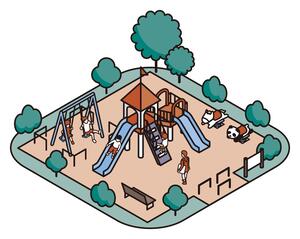
Parks are everyone's property. It's important to be mindful of others and the environment in order to use them safely and have a good time. To help everyone enjoy the park peacefully, please follow these guidelines based on Japanese customs and manners:
Guidelines for using city parks
Consideration to others
- Keep your voice down and avoid loud music or noise.
- Do not take over the space or play equipment.
- Please do not smoke on the premises, as the park is visited by many young children.
Environment and wildlife
- Take your garbage home with you. Do not litter, including liquid and food.
- Do not feed wild animals, such as cats and pigeons.
- Keep your pets on a leash and clean up after them.
- Do not harm or collect plants, animals, or insects*. Do not plant any vegetation.
Safety guidelines
- Do not engage in activities that endanger yourself or other park users (such as baseball* or golf practice, or setting off large fireworks).
- Barbecues and open flames are not allowed except in designated areas.
- You cannot operate drones or fly RC planes.
- Do not bring glass or metal items into the sandbox.
*While insect collecting is permitted in some parks, please refrain from excessive collecting to minimize impact on the ecosystem.
*Simple ball games are not prohibited, but please play with sufficient consideration so as not to disturb others or the neighborhood.
Precautions for Playing in the Park
- Strings can be extremely dangerous if they get caught on playground equipment. Avoid wearing clothing with drawstrings, such as hoodies, as well as scarves, necklaces, bags, and water bottles with straps while playing. Also, make sure shoelaces are tied securely, as loose laces can get caught or cause falls.
- Playground equipment may become very hot on hot days. Please check it before use to avoid getting burned.
- Please be careful around moving playground equipment, such as swings, and avoid playing too close to them.
- Please be careful not to let the ball go outside the park or onto the road when using it.
Contact
If you notice any abnormalities/malfunctions in the park or its facilities, please contact the Park and Green Spaces Division (Koen Ryokuchi-ka).
Town Planning Dept., Park and Green Spaces Div.
TEL:047-366-7380
Address: 136-2 Takegahana, Matsudo City
Playing with Hand-held Fireworks / 手持ち花火の使用について
There are many kinds of handheld fireworks in Japan, and they are popular with everyone from kids to grownups. You can play with fireworks in parks in Matsudo City, but please be considerate of the neighbors and follow the instructions for safe use.
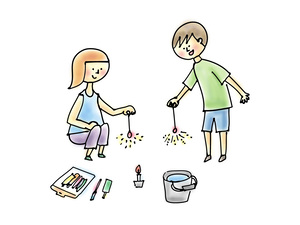
- Prepare a bucket of water and garbage bags in advance.
- Do not play late at night after 9:00 p.m.
- Rocket fireworks, bottle rockets, and firecrackers are prohibited.
- Do not aim fireworks at people or buildings.
- Do not take apart fireworks or light them in any way other than as instructed.
- Be sure to take home any burnt debris and garbage and clean up after yourself.
※Depending on the park, fireworks may be prohibited or permitted only in certain areas.
Please check the park rules in advance.
Contact
Town Planning Dept., Park and Green Spaces Div.
TEL:047-366-7380
Matsudo Fire Department, Prevention Division (Yobo-ka)
TEL: 047-363-1114
Life with Pets / ペットとのくらし
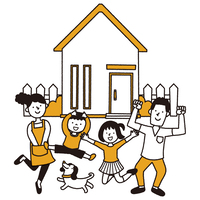
Responsibilities and Considerations All Pet Owners Must Keep in Mind
- Keeping pets in rental properties requires permission from the landlord or real estate agency.
- When using public transportation, always place your pet in a carrier large enough to fully contain it. Check with the transportation company beforehand, as size and weight restrictions may apply, and fees may be charged.
- Do not let your pet loose outside.
- Have your pet microchipped.
- Never abandon your animal.
- Prepare for disasters and train your pet accordingly.
To Dog Owners
- Registration at City Hall (once in a lifetime) and rabies vaccination (once a year) are required.
- Attach a license tag. (Dogs registered on the Ministry of Environment database via microchip are exempt from this requirement.)
- Notify City Hall if the dog's location or owner changes, or if the dog dies.
- Dispose of waste at home. Do not leave it behind during walks.
- If urine or feces soils roads, utility poles, buildings, etc., clean it up by rinsing the area with water.
- Never walk your dog off-leash.
- Be careful not to disturb the neighborhood with excessive barking or odors.
To Cat Owners
- Keep your cat indoors at all times.
- All toileting and feeding should take place indoors.
- For your cat's safety, put a collar on your cat and have it microchipped.
- Please spray or neuter your cat.
Disposal of Animal Carcasses
When Your Pet Passes Away
■ Cremation/Burial Service
Matsudo City does not operate any related facilities such as municipal pet cemeteries.
Please contact private pet cremation/cemetery facilities.
*You can search for “pet cemetery, matsudo” online.
■ Incineration
The remains of deceased animals can be entrusted for incineration at the Wanagaya Waste Management Center.
Please note that as this is not an animal-specific incinerator, ashes cannot be returned.
There are two methods for requesting incineration of remains:
- a) Request for home collection
・Request collection by phone. Please provide your name, address, and contact information.
・Hand over the body to the collection staff and complete the application form on-site.
・Pay the fee at a financial institution counter within the deadline using the payment slip sent later by the Waste Management Division.
・Fees: 1,650 yen per body - b) Bring the animal remains to the facility yourself
・Print out and complete the Animal Remains Disposal Application Form.
・Call the Wanagaya Waste Management Center (047-392-1118) to apply for facility drop-off.
・Bring the remains to the facility, along with the Animal Remains Disposal Application Form, identification, and your personal seal.
・Later, use the payment slip sent by the Waste Management Division to pay the fee at a financial institution counter within the deadline. - ・Fees: 1,100 yen per body
For detailed procedures, please check the Wanagaya Waste Management Center website.
Animal Remains Disposal Application Form (Japanese) / 動物死体処理申請書(PDF:108KB)
If you find a dead animal on the road or elsewhere
If you find a dead wild animal on the road or on your property, please contact the inquiry number below.
Please provide the address or a landmark building, and a city staff will come to collect it.
Depending on the location, your presence may be required.
※ No fees apply
REFERENCE:
'Animal Carcass Disposal (Japanese)'
Contact
[For Inqiuries・Registration of Dogs] Environmental Conservation Division
TEL: 047-366-7336
Address: 6F New Building, 387-5 Nemoto, Matsudo City
[For Disposal of Wild Animal Carcasses] Household Garbage Call Center
TEL: 0120-264-057
Return to 'For Foreign Residents' page /「外国人市民向けの資料」のページへ戻る
PDF形式のファイルを開くには、Adobe Acrobat Reader(旧Adobe Reader)が必要です。
お持ちでない方は、Adobe社から無償でダウンロードできます。