


「レッツゴー キャム!」Cam, Ikuzo! Come follow Camden’s journey! January 2026
更新日:2026年1月1日
Japan’s Train Stations Supporting Daily Life
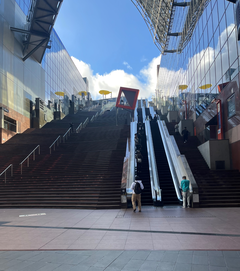
Grand Staircase at Kyoto Station
From December 8th to 12th, I participated in a translation and interpretation training course for JET Programme ALT (Assistant Language Teacher) and CIR (Coordinator for International Relations) participants, held in Shiga Prefecture. I spent a wonderful five days at a facility near Lake Biwa, where myself and fellow JETs worked hard to hone our interpreting skills.
After the training, I had a few hours of free time at Kyoto Station before my shinkansen (bullet train) departure. However, it was kind of an awkward waiting period where I didn’t have quite enough time to leave the station and enjoy something elsewhere, but it was also just long enough to feel like a drag to stick around in the station. At first, I wasn’t sure what I should do to pass the time, but as I walked around the station, I realized that Kyoto Station’s scale was completely different from other stations. What particularly surprised me was the 171 step “Grand Staircase” on the west side of the Kyoto Station building. It was so large that I just stopped and looked up at it for a second in amazement. Even though I was not planning to buy anything, I could not help but want to look around the giant building and window shop just out of curiosity to see what kind of shops were in there. It really did feel like it was a station designed for people in my situation, trying to pass time during an awkward waiting period.
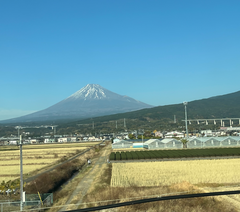
View of Mt. Fuji from shinkansen
As someone from a very car-dependent society that is the United States, because American train stations lack such facilities, even after living in Japan for three years the idea of a train station as a place to “spend time” still feels fresh to me. My experiences with traveling by train in my home country were rare in the past, perhaps once a year at most. For example, when traveling from my hometown in Maine to Boston, I on some occasions rode a train called the “Amtrak Downeaster.” Unlike the bullet train, it doesn’t accelerate at high speeds, nor does it offer breathtaking views on the level of Mount Fuji, but having a reserved seat and more space than a bus or car made it a very relaxing travel experience for me. In Japan as well, every time I take a train in Japan where I can sit in my designated seat, I find it very easy to relax so I always look forward to it.
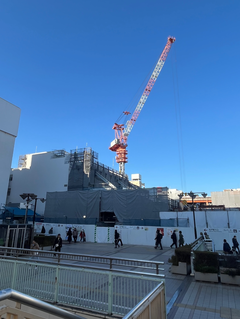
Ongoing renovation at Matsudo Station
I am sure that those who live in Matsudo City are likely already aware that renovation work is currently underway at Matsudo Station. I was curious if, like Kyoto Station, Matsudo Station was planning to become a "place to hang around," so I looked up the plans. It turns out that the plan is less so focused on creating a space to “spend time," but rather one of their objectives is improving "convenience," such as widening the corridors and adding more convenience stores to make the station easier to navigate and use in daily life. While there might have been an option to turn the station into a place that is better for "hanging out," like Kyoto Station, but I realized that for Matsudo Station to continue supporting daily life, such as commuting, attending school, and shopping, the highest priority definitely should be convenience. In fact, that has already been the city’s priority, as Matsudo City has been awarded 1st place in the National Rankings and 2nd place in the Overall Rankings of the “2025 Rankings of Cities That Are Easy to Raise Children and Work” by Nikkei and Nikkei Cross Woman. In the same ranking Matsudo has maintained 1st place in Chiba Prefecture for 9 consecutive years since 2017. With many energetic families living in Matsudo, I’m really looking forward to how the improvements in station convenience will make daily life more comfortable and help Matsudo grow into an even more child-friendly and livable city.
日本の駅が支える日常
京都駅の「大階段」
12月8日から12日まで、滋賀県で行われたJet ProgrammeのALT(外国語指導助手)とCIR(国際交流員)が受講できる翻訳・通訳講座の集合研修に参加してきました。琵琶湖近くの施設で過ごしながら、Jet Programmeの仲間たちと切磋琢磨し、通訳に関するスキルを向上させるための本当に素晴らしい5日間を過ごしました。
研修後の帰りに、京都駅から乗る新幹線の出発時刻まで少し時間が空いていました。ただし、その数時間は駅から離れてどこかで楽しむには足りず、駅に残るには少し長く感じる微妙な待ち時間であり、最初は何をして過ごせばよいか悩んでいました。しかし、駅で少し歩き回ってみると、京都駅の規模が他の駅とは全く異なることに気づきました。特に驚いたのは、京都駅ビル西側にある、171段の「大階段」でした。駅の中とは思えないほどの規模で、思わず立ち止まって見上げてしまいました。また、駅の中にはウインドーショッピングを楽しめる場所がたくさんあり、特に買い物をする予定がない人でも、どんなお店が入っているのか、気になると思います。まるで私のような「微妙な待ち時間」を過ごしている人のために作られたかのようでした。
新幹線から見た富士山
車社会のアメリカ出身の私にとって、アメリカの駅はそのような設備で充実していないため、「駅で過ごす」ということが、来日して3年経った今でも新鮮に感じられます。電車の中で過ごす経験も、以前は一年に一度あるかないかの程度でした。私の出身地であるメイン州からボストン市まで移動する際には、Amtrak Downeaster(アムトラック・ダウンイースター)という列車に乗ったことがあります。新幹線のような高速運転はできず、富士山のような絶景が見られるわけでもありませんが、決まった座席があり、バスや車よりもゆったりとした空間で過ごせるため、私にとって電車での移動はとてもリラックスできる時間でした。日本でも、自分の席に座って移動できる電車に乗るたびに、今でも少し楽しみな気持ちになります。
松戸駅で行われている改修工事
松戸市に住んでいる方はご存じだと思いますが、現在、松戸駅では改良工事が行われています。京都駅のように、松戸駅を「過ごせる場所」にしていく計画なのかどうか気になり、調べてみました。目的の一つに、過ごせる空間づくりというよりも、通路の拡幅やコンビニエンスストアの増設など、利用者の動線や日常の使いやすさを重視した「利便性向上」を目的とした計画であることが分かりました。京都駅のように「駅で過ごす場所」を作るという選択肢もあったかもしれませんが、一方で、松戸駅が通勤や通学、買い物など、日々の生活を支える場所としての役割を果たすためには、何よりも「利便性の向上」が最も重要であることに気づきました。実は松戸市は、日経新聞社と日経xwomanが発表する「共働き子育てしやすい街ランキング2025」において、全国編で1位、総合編で2位を受賞しています。千葉県内のランキングでは、2017年から9年連続で1位を維持しています。元気に暮らす子育て世帯が多い松戸市で、駅の利便性向上が進むことで、日々の暮らしがさらに快適になり、松戸がこれまで以上に子育てしやすく、住みやすいまちへと成長していくのを、とても楽しみにしています。
 松戸市の「国際交流員」 Matsudo City's Coordinators for International Relations